
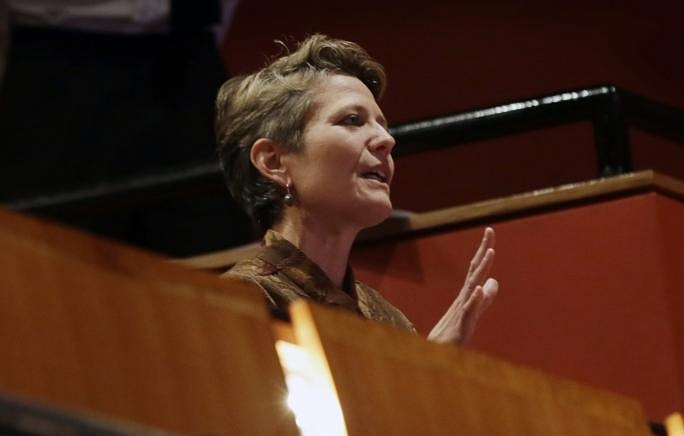
Aug. 16, 2026—The Russian news agency TASS provided prominent English-language coverage this morning of the independent presidential candidacy of Diane Sare, a long-time associate of the renowned American economist and statesman Lyndon LaRouche. Accompanied by a large picture of Sare speaking, the headline reads: “US should avoid tensions with Russia ahead of elections—candidate for president. The White House should seek to expand trade and joint projects in the spirit of Anchorage, said Diane Sare.” TASS also published a Russian-language version of the interview. The full text of the English-language article follows:
WASHINGTON, August 16. /TASS/. The administration of US President Donald Trump should avoid escalating tensions with Russia ahead of the midterm congressional elections and instead seek to expand trade and joint projects in the spirit of Anchorage, independent candidate for US President Diane Sare told TASS.
“Luckily, the United States is having midterm elections in November. The American people are weary of war, and this may impact the Trump administration’s thinking on whether it is wise to escalate the conflict against Russia. Not to mention that, between arming Ukraine and Israel, and attacking Iran, we have depleted our own conventional munitions to very low levels,” Sare said.
She announced in January that she would run as an independent candidate in the 2028 presidential election.
Sare called the US intelligence community and Pentagon providing Kiev with data for strikes on Russian territory “unfortunate and destructive.” “It would be far more productive to revive the spirit of Alaska and emphasize the enormous benefits to be reaped on both sides by cooperation in trade and development on such projects as the Bering Strait Tunnel and the Northern Sea Transport Route,” the presidential candidate said.
Sare said the US could immediately pledge not to be the first to use nuclear weapons, arguing that this “would help to alleviate some uncertainty and further the negotiating process.”
“Unfortunately, this is not what is being expressed by our Under Secretary of War for Policy, Elbridge Colby, who seems to be saying the opposite with regard to the use of tactical nuclear weapons,” she said, referring to the Pentagon official’s remarks that the US “must carry the biggest stick in the world.”
Russian President Vladimir Putin and US President Donald Trump met in Anchorage, Alaska, on August 15 last year. Putin later said the so-called spirit of Anchorage was not formalized in any documents or signed by either side. The summit focused on ways to end the conflict in Ukraine.
Russian Media Widely Reports on Sare’s TASS Interview
The TASS interview with Diane Sare appeared in Russian as well as English, and has been picked up widely. Internet aggregators rambler.ru, dzen.ru, and life.ru summarized the TASS release, as did vesti.ru, the website of state television. Some of the websites added relevant details, such as that Rep. Anna Paulina Luna (R-FL) has likewise called for renewing Russian-American dialogue.
Tsargrad TV, a popular conservative news and analysis channel, restated the content in their own words on its website, and added a few confirmatory citations and other points:
“Experts at Foreign Policy magazine recently noted that the U.S. defense agency really is far from unified on this question, and that Colby’s statements annoy some of the senior officers.”
“Instead of confrontation, Sare proposes to rely on what was agreed at Vladimir Putin and Donald Trump’s meeting in Anchorage, August 15, 2025. She enumerated several specific areas: building a tunnel across the Bering Strait, development of the Northern Sea Route, potential participation by ExxonMobil in the Sakhalin-1 project [ExxonMobil operated it until 2022—ed.], and joint mining of rare earth metals. In Sare’s opinion, trade cooperation is far more beneficial for the U.S. economy, writes TASS.”
On the exhaustion of U.S. munitions, they add: “The military analytical site Defense News has reported that replenishing these reserves will take at least two years and billions in spending, which is especially sensitive in the setting of the November midterm elections for Congress.”